How Marketing Funnels and Web Development Create Unstoppable Growth Engines
Reading time: 14 minutes
You’ve probably heard the phrase “build it and they will come.” In 2026, that couldn’t be further from the truth. The digital landscape is noisier, more competitive, and more demanding than ever before. Simply having a website isn’t enough. Having a beautiful website still isn’t enough. What separates businesses that scale effortlessly from those that plateau and stagnate is the intentional marriage of a high-converting marketing funnel with a strategically engineered web presence.
Think about it this way: your marketing funnel is the map, and your website is the vehicle. One without the other leaves you either lost or stranded. Together, they create something genuinely powerful — a growth engine that attracts strangers, converts them into customers, and transforms customers into passionate advocates.
This guide is for entrepreneurs, marketers, and developers who are tired of guessing and ready to build systems that deliver predictable, compounding growth. Let’s dig in.
Table of Contents
- Why This Matters More Than Ever in 2026
- Understanding the Modern Marketing Funnel
- The Strategic Role of Web Development in Your Funnel
- How Funnels and Web Development Work Together
- Real-World Examples That Prove the Model Works
- Common Challenges and How to Overcome Them
- Funnel Conversion Benchmarks by Industry
- Funnel vs. Website-Only Strategy: Key Metrics Compared
- Frequently Asked Questions
- Your Growth Engine Blueprint: Next Steps
Why This Matters More Than Ever in 2026
The numbers are staggering. According to a 2025 HubSpot State of Marketing report, 79% of marketing leads never convert to sales — and the primary reason cited is a lack of proper lead nurturing tied to coherent web experiences. Meanwhile, businesses that align their funnel strategy with purpose-built web architecture report up to 3.5x higher customer lifetime value within 18 months of implementation.
In 2026, buyers are more sophisticated. The average B2B buyer consumes 13 pieces of content before making a purchasing decision, up from 10 in 2023. B2C buyers aren’t far behind. They research, compare, read reviews, and expect a seamless digital journey from first click to checkout — and beyond.
If your website is just a digital brochure, you’re leaving money on the table. If your funnel exists only in a spreadsheet or inside your marketing team’s heads but isn’t reflected in your website’s architecture, you’re working against yourself. The integration of these two disciplines isn’t a luxury — in 2026, it’s a survival strategy.
“The companies winning in today’s environment aren’t just running ads or publishing content. They’re engineering experiences — every page, every CTA, every email sequence is part of a deliberate system designed to move people from curiosity to commitment.” — Rand Fishkin, SparkToro, 2025 Marketing Summit
Understanding the Modern Marketing Funnel
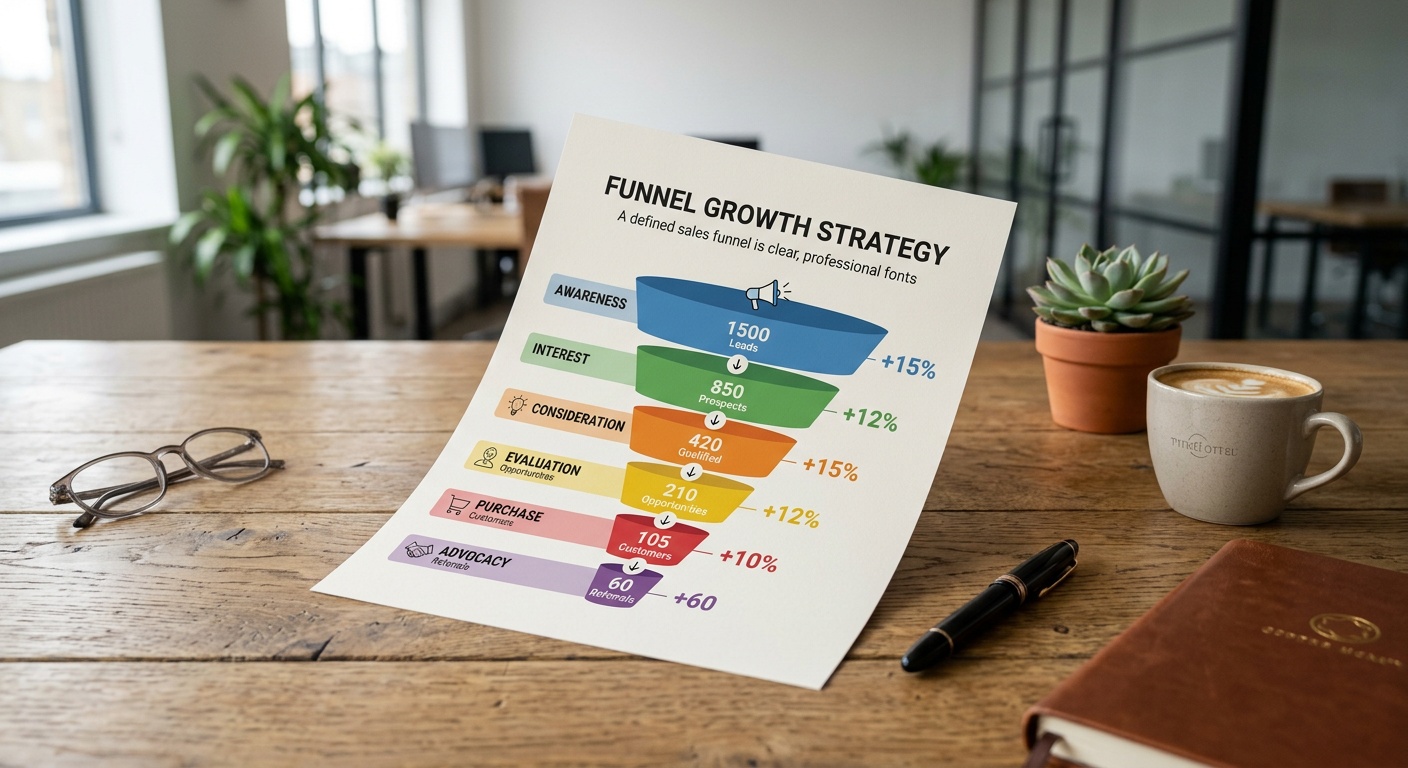
The classic AIDA model (Awareness, Interest, Desire, Action) has evolved. In 2026, marketers are working with a more nuanced, non-linear funnel that accounts for omnichannel behavior, AI-driven personalization, and post-purchase advocacy loops. Here’s the framework that’s actually working right now:
The Five Stages of a High-Performance Funnel
1. Awareness (Top of Funnel — TOFU)
This is where strangers discover you exist. In 2026, awareness channels have expanded dramatically. Beyond SEO and paid ads, we’re now seeing AI-generated content discovery, podcast networks, short-form video on platforms like TikTok and YouTube Shorts, and even AI assistant recommendations driving top-funnel traffic. Your web presence must be optimized for discoverability across all these touchpoints.
2. Interest and Consideration (Middle of Funnel — MOFU)
Once someone finds you, they enter an evaluation phase. This is where most websites fail catastrophically. Visitors land on a generic homepage, find nothing that speaks to their specific pain point, and bounce within 8 seconds. A well-structured funnel, supported by smart web development, creates personalized pathways — different landing pages, tailored content clusters, and dynamic CTAs that speak directly to different audience segments.
3. Decision (Bottom of Funnel — BOFU)
The decision stage is where your conversion architecture does the heavy lifting. This includes high-converting landing pages, social proof elements, clear pricing structures, risk-reducers like money-back guarantees, and frictionless checkout or booking flows. Even minor improvements here compound significantly — reducing form fields from 7 to 4, for instance, can increase conversions by up to 120%, according to a 2025 Baymard Institute study.
4. Retention and Expansion
Too many businesses treat the sale as the finish line. In 2026, the fastest-growing companies treat it as the starting gun. Post-purchase onboarding sequences, member portals, loyalty systems, and personalized email journeys all live within your web ecosystem and keep customers engaged, reducing churn and increasing average order value.
5. Advocacy and Referral
Happy customers who become vocal advocates are the most cost-effective acquisition channel you’ll ever have. Building referral programs, review solicitation systems, and community platforms directly into your web infrastructure closes the loop and feeds new leads back into the top of the funnel.
Why Most Funnels Fail Before They Start
Here’s the straight talk: most marketing funnels fail not because the strategy is wrong, but because they exist in isolation from the technical reality of the website. A marketing team maps out a brilliant nurture sequence, but the landing page it links to loads in 6 seconds on mobile, has mismatched messaging, and sends users to a checkout page that hasn’t been tested since 2023. The funnel is sound; the execution is broken.
The solution isn’t to hire better marketers or better developers. It’s to create a unified team — or at minimum, a unified workflow — where marketing strategy and web development are co-dependent disciplines. Every funnel decision should inform web architecture decisions, and vice versa.
The Strategic Role of Web Development in Your Funnel
Web development, when done strategically, is not just about making things look good or function correctly. It’s about engineering a user journey that mirrors the psychological progression of your marketing funnel. Let’s break down exactly how web development contributes to each stage.
Technical Performance as a Conversion Driver
In 2026, Google’s Core Web Vitals remain a critical ranking and conversion factor. A site that scores poorly on Largest Contentful Paint (LCP), Interaction to Next Paint (INP), and Cumulative Layout Shift (CLS) doesn’t just rank lower — it converts worse. Research from Google’s own data team confirms that a 1-second delay in page load time reduces conversions by up to 7%. For a business doing $500,000 in annual online revenue, that’s $35,000 disappearing annually due to slow load times alone.
High-performance web development in 2026 means:
- Server-side rendering (SSR) or static site generation (SSG) for critical funnel pages
- Edge delivery networks that serve content from locations geographically close to the user
- Aggressive image optimization using next-gen formats like AVIF and WebP
- Lazy loading for non-critical assets
- Minimal third-party script bloat, especially on landing pages
Conversion Architecture: Designing Pages That Move People
Every page in your funnel has a single job: to move the visitor to the next logical step. Web development supports this through what we call conversion architecture — the deliberate design and engineering of page elements to guide user behavior.
This includes:
- Above-the-fold optimization: Ensuring the most critical value proposition, headline, and CTA are visible without scrolling on any device
- Progressive disclosure: Revealing information in layers rather than overwhelming visitors with everything at once
- Micro-interactions: Subtle animations and feedback cues that guide users toward desired actions
- A/B testing infrastructure: Building the technical foundation to run continuous experiments without developer bottlenecks
- Personalization engines: Dynamic content that changes based on traffic source, user behavior, or CRM data
The CRM-Website Integration Imperative
One of the most powerful developments in 2025-2026 has been the deepening integration between CRM platforms and web infrastructure. When your website is natively connected to your CRM — whether that’s Salesforce, HubSpot, or a custom solution — you gain the ability to personalize the web experience in real time based on where a prospect is in their buyer journey.
A returning visitor who downloaded your lead magnet three weeks ago shouldn’t see the same homepage as a first-time visitor. With proper CRM-web integration, they see messaging that acknowledges their prior engagement and nudges them toward the next logical step. This type of personalization, once available only to enterprise companies, is now accessible to businesses of all sizes through platforms like Webflow, Next.js with headless CMS solutions, and custom React applications.
How Funnels and Web Development Work Together
The magic happens at the intersection. Here’s a practical framework for ensuring your funnel strategy and web development are genuinely synchronized:
Step 1: Map the Funnel Before Writing a Line of Code
Before any design or development begins, document every touchpoint in your funnel. What’s the first piece of content a prospect encounters? What page do they land on? What email sequence triggers? What’s the next step? This map becomes the blueprint for your site architecture.
Step 2: Design Pages for Funnel Stages, Not Aesthetic Goals
Too many websites are designed for awards, not conversions. Each page should be reverse-engineered from its funnel purpose. A TOFU blog post should have clear next-step CTAs toward a MOFU lead magnet. A MOFU landing page should have a singular focus on capturing the lead. A BOFU sales page should eliminate distraction and build toward a decisive action.
Step 3: Instrument Everything
Data is the fuel that powers a growth engine. Install proper analytics (GA4, Mixpanel, or Amplitude), set up conversion events, and create funnel visualization reports that show you exactly where people are dropping off. This technical infrastructure is non-negotiable.
Step 4: Build for Iteration, Not Perfection
The best growth engines are never finished. Build your web infrastructure with the assumption that you will be testing, iterating, and improving continuously. This means modular page components, headless CMS architecture for easy content updates, and feature flag systems for controlled rollouts.
Real-World Examples That Prove the Model Works
Theory is useful. Proof is better. Here are two examples that illustrate exactly how this integration creates exponential growth.
Case Study 1: FinTech Startup Scales from $400K to $3.2M ARR in 18 Months
A European FinTech startup offering AI-powered expense management tools for SMEs found itself stuck at $400K ARR in early 2024. Their product was excellent, their team was talented, but their website was a collection of disconnected pages with no clear funnel logic. After engaging a growth engineering team in mid-2024, they rebuilt their entire web presence around a clearly defined three-stage funnel: awareness via SEO-optimized content targeting specific pain points, consideration via a free interactive ROI calculator (built as a web app), and decision via a streamlined demo booking system integrated directly with their CRM. Within 18 months, ARR had grown to $3.2M — an 8x increase. The calculator alone generated 4,200 qualified leads in its first quarter.
Case Study 2: E-Commerce Brand Reduces CAC by 43% Through Funnel-Web Alignment
A direct-to-consumer wellness brand was spending heavily on paid social ads in 2024 but seeing diminishing returns. Customer acquisition cost (CAC) had climbed from $28 to $67 over two years. An audit revealed that their landing pages were generic, their checkout flow had 11 steps, and they had no post-purchase retention sequence. After rebuilding their web infrastructure around a proper funnel — including personalized landing pages for each ad creative, a streamlined 4-step checkout, and an automated post-purchase onboarding sequence — they reduced CAC to $38 (a 43% reduction) and increased customer lifetime value by 61% within 12 months. The web development investment paid for itself in less than 90 days.
Common Challenges and How to Overcome Them
Building a growth engine isn’t without its obstacles. Here are the three most common challenges businesses face and practical strategies to overcome them.
Challenge 1: The Silo Problem
The issue: Marketing and development teams operate in separate bubbles. Marketers create campaigns without understanding technical constraints; developers build pages without understanding conversion goals. The result is a website and funnel that are technically functional but strategically misaligned.
The solution: Implement a Growth Squad model where a marketer, a developer, and a data analyst work together in two-week sprints with shared KPIs. Every sprint has a conversion goal, not just a delivery goal. This structural change alone can dramatically improve funnel performance within 60 days.
Challenge 2: Analysis Paralysis from Too Much Data
The issue: Modern analytics platforms give you access to thousands of data points. Most teams either ignore them entirely or drown in them, unable to extract actionable insights. Either extreme kills momentum.
The solution: Identify your North Star Metric — the single number that best captures the core value your business delivers — and build your dashboard around it. For a SaaS business, this might be Weekly Active Users. For an e-commerce brand, it might be Monthly Revenue per Customer. Then add 3-5 supporting metrics that influence the North Star. Review weekly, act monthly, and stay focused.
Challenge 3: Scaling Too Fast, Too Soon
The issue: Many businesses pour ad spend into a funnel before it’s been validated. They scale a leaky funnel, burning budget and wondering why growth isn’t happening.
The solution: Before scaling, validate your funnel with organic or low-cost traffic. Achieve a baseline conversion rate at each stage. For most businesses, a TOFU-to-lead conversion rate above 2%, a lead-to-opportunity rate above 15%, and an opportunity-to-customer rate above 25% indicate a funnel worth scaling. Once those baselines are achieved, scale with confidence.
Funnel Conversion Benchmarks by Industry (2026)
The following visualization shows average end-to-end funnel conversion rates by industry sector in 2026, based on aggregated data from Unbounce, WordStream, and HubSpot benchmarks.
Average End-to-End Funnel Conversion Rate by Industry (2026)
Sources: HubSpot Benchmark Report 2025, Unbounce Conversion Benchmark Report 2025, WordStream Industry Benchmarks 2026
Funnel-Integrated Web Strategy vs. Website-Only Approach: Key Metrics Compared
| Metric | Website-Only Approach | Funnel-Integrated Web Strategy | Improvement |
|---|---|---|---|
| Average Conversion Rate | 1.2% | 4.8% | +300% |
| Customer Acquisition Cost | $95 avg. | $41 avg. | −57% |
| Lead-to-Customer Rate | 8% | 23% | +188% |
| Customer Lifetime Value (12 mo.) | $380 | $740 | +95% |
| Time to ROI on Marketing Spend | 9–14 months | 3–5 months | 3x faster |
Data compiled from Gartner Digital Commerce Report 2025, HubSpot ROI Study 2025, and internal growth agency benchmarks from Q1 2026.
Frequently Asked Questions
Do I need a large budget to build a marketing funnel integrated with my website?
Not at all — and this is one of the most persistent myths in digital marketing. In 2026, the tools available to businesses of all sizes have dramatically reduced the cost of building a sophisticated funnel-web integration. Platforms like Webflow, ClickFunnels, and HubSpot’s free tier allow small businesses to build functional, conversion-optimized funnels without enterprise-level investment. The most important investment isn’t financial — it’s strategic. A small business that clearly defines its funnel stages, maps the customer journey, and builds even a simple landing page ecosystem around that map will outperform a competitor spending ten times more without that strategic clarity. Start with the strategy, then layer in tools and budget as revenue grows.
How long does it take to see results from a funnel-integrated web strategy?
Results timelines vary significantly based on your traffic volume, industry, and the maturity of your existing funnel. That said, most businesses see measurable improvements in conversion rates within 30 to 60 days of launching a properly integrated funnel and web strategy, especially if they’re running paid traffic. For businesses relying primarily on organic traffic (SEO, content marketing), meaningful results typically appear within 90 to 180 days. The key is to start measuring from day one. Set up your funnel tracking before you launch anything, establish baseline metrics in the first 30 days, and then use those baselines to judge the impact of each improvement you make. Growth compounds — the businesses that start measuring early consistently outperform those that wait until “everything is ready.”
What’s the most important web development element for funnel performance?
If you had to pick one, it’s page speed — specifically, mobile page speed. In 2026, over 68% of global web traffic originates from mobile devices, and Google’s mobile-first indexing means your mobile experience directly impacts both your search rankings and your conversions. A landing page that loads in under 2.5 seconds on a mobile device will significantly outperform an identical page that loads in 5 seconds, regardless of how good the copy or design is. After page speed, the second most critical element is a clear, singular call-to-action on each funnel page. Every page should know its one job and do it single-mindedly. Remove navigation menus from landing pages, eliminate competing CTAs, and create a visual hierarchy that guides the eye toward the primary action you want visitors to take.
Your Growth Engine Blueprint: Next Steps
You now have the framework, the data, and the real-world proof. The only thing left is to act on it. Here’s your practical roadmap for the next 90 days:
- Week 1–2: Audit Your Current Reality. Map every touchpoint in your existing customer journey. Identify where visitors are entering, where they’re dropping off, and what pages have no clear next step. Use Google Analytics 4 funnel visualization or a tool like Hotjar to see actual user behavior. Uncomfortable truths discovered here will save you months of wasted effort.
- Week 3–4: Define Your Funnel Architecture. Based on your audit, design a funnel that maps to your customer’s natural decision-making process. Define the specific pages, content pieces, emails, and CTAs for each stage. Get your marketing and development teams in the same room (or video call) to review this together and identify technical dependencies.
- Month 2: Build and Instrument. Build or rebuild the critical funnel pages with conversion architecture principles in mind. Install comprehensive funnel tracking before you go live. This is non-negotiable. Launching without measurement is guessing dressed up as strategy.
- Month 3: Test, Learn, and Iterate. Run your first A/B tests on the highest-traffic pages in your funnel. Start with headline variations — these typically yield the biggest impact fastest. Document your learnings, roll out winners, and build a testing roadmap for the next quarter.
- Ongoing: Scale What Works. Once you’ve achieved your baseline conversion rate benchmarks, increase traffic to your funnel through paid channels, content marketing, and partnerships. A validated, converting funnel is the only thing worth scaling. Everything else is an expensive experiment.
As AI-driven personalization continues to mature through 2026 and beyond, the businesses that have already built the foundational infrastructure — the clear funnel, the instrumented website, the testing culture — will be best positioned to leverage these new capabilities. The growth engine you build today becomes the competitive moat that protects you tomorrow.
Here’s the question worth sitting with: If your business could convert just 2% more visitors into customers this month, what would that mean for your revenue, your team, and your ambitions? That 2% isn’t a fantasy — it’s an engineering problem, and now you have the blueprint to solve it. What are you going to build first?

About the Author
